Florida businesses leave millions on the table every year, not because of bad products or slow sales, but because of unpaid invoices sitting in aging accounts receivable reports. If your AR report shows balances pushing 90 days or older, you're already losing ground. Contact HF Holdings Inc. at (877) 680-6064 today to find out what your overdue accounts are actually worth recovering.
From busy commercial corridors near Downtown Miami to mid-sized distributors operating out of Tampa's Westshore district, B2B cash flow problems don't discriminate by industry or company size. The good news: knowing when and how to act makes a measurable difference in how much you actually get back.
Why Does Debt Age Hurt Recovery Rates So Much?
The older a commercial debt gets, the harder it is to collect. Accounts placed for recovery within the first 90 days have an average collection success rate of around 73%. That rate drops to roughly 57% at the 6-month mark and falls below 25% for accounts older than two years.
This isn't a mystery. Debtors change ownership structures. Businesses close, move, or dissolve. Contacts leave companies. Every week that passes without professional action gives the debtor more time to create distance between themselves and the obligation. For Florida enterprises, where many businesses operate on thin seasonal margins, that window closes faster than financial managers often expect.
The lesson is simple: speed is a strategy. Waiting 120 days to refer an account to a professional debt collection agency isn't cautious; it's costly.
What Makes Florida's Commercial Collection Laws Different?
Florida follows a 5-year statute of limitations for written contracts under Florida Statute 95.11(2)(b). Oral contracts carry a 4-year limit. For financial managers tracking a portfolio of B2B receivables, this means a claim that felt "manageable" at month six can become legally unenforceable if ignored past the deadline.
Florida also falls under the federal Fair Debt Collection Practices Act (FDCPA), though its primary protections target consumer debt. Commercial collections operate with more flexibility, but that doesn't mean anything goes. Florida businesses must still comply with proper notice requirements, and any judgment collections in Florida must follow Florida Statute Chapter 56 when it comes to enforcement, including wage garnishment and bank levies.
One detail that surprises many financial managers: winning a judgment in court doesn't automatically result in payment. Judgment collections in Florida require active enforcement steps. You may need to pursue a writ of execution, conduct a debtor examination, or garnish a bank account. Without someone actively working the judgment, that court order sits in a drawer. Working with an experienced partner who handles judgment collections in Florida can mean the difference between a piece of paper and actual recovered funds.
Internal Recovery vs. Professional Agency: When Should You Make the Switch?
Most finance teams start with internal collection efforts. Phone calls, demand letters, account statements. That's reasonable for balances under 30 days past due. But internal teams face real limitations: limited skip tracing tools, no formal legal leverage, and a working relationship with the debtor they often don't want to damage.
Here's a practical framework for timing the transition to a professional debt collection agency:
- 30-60 days past due: Internal follow-up, re-send invoice, confirm contact details
- 60-90 days past due: Formal written demand, phone escalation, flag account for external review
- 90+ days past due: Refer to a professional commercial collection agency
- Post-judgment: Immediately engage a recovery team experienced in judgment collections in Florida
The "No Recovery, No Fee" model used by HF Holdings Inc. removes the financial risk of early referral. You don't pay unless funds are recovered. That model eliminates the most common reason finance teams delay: the fear that collection fees will eat into whatever small recovery they might get.
Many debts placed with a professional agency are collected within 30 to 90 days. That's a significantly faster cycle than most internal escalation processes, which tend to stretch past the 6-month mark before a firm decision gets made.
If your accounts involve unpaid utility balances, utility debt collection services follow specialized regulatory frameworks and require industry-specific expertise. When accounts reach the litigation threshold, engaging a debt collection attorney through an established recovery network gives you legal leverage without requiring your team to manage the attorney relationship directly.
How Does Faster Recovery Actually Fuel Business Growth?
Cash flow and growth aren't separate conversations. They're the same conversation. A Florida distribution company near the Port of Tampa carrying $200,000 in overdue receivables isn't just dealing with a bookkeeping problem. That's $200,000 that isn't covering payroll, buying inventory, or funding a new hire.
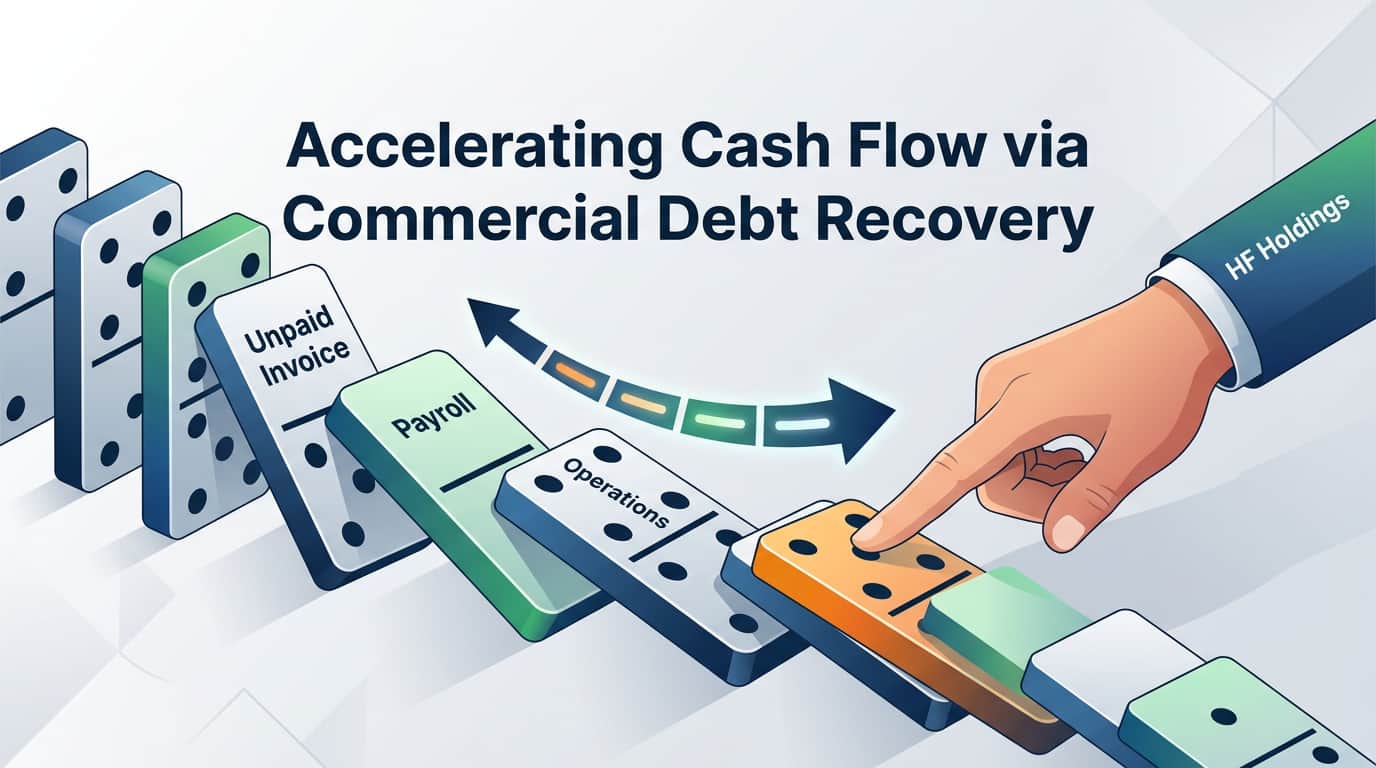
The domino effect of unpaid B2B invoices is well documented:
- Delayed supplier payments trigger strained vendor relationships
- Credit line draws to cover shortfalls add interest costs, often 6-9% annually on revolving credit
- Internal resources spent on collections pull focus from revenue-generating activity
- Write-offs reduce taxable income but eliminate cash permanently
Businesses that recover outstanding balances 30-45 days faster than the industry average consistently report 15-20% improvements in operating cash position, which directly supports reinvestment in growth.
For Florida enterprises specifically, seasonality amplifies this effect. A business in the Miami Design District or along Fort Lauderdale's commercial corridor that enters slow season with clean receivables is in a fundamentally stronger position than one dragging 90-day-old accounts into a revenue dip.
Judgment collections in Florida add another layer: if your business has already gone through litigation and received a money judgment, that asset has a shelf life. Florida judgments are valid for 20 years and can be renewed, but active enforcement during the early years, when a debtor still has accessible assets, produces far better results than waiting.
What Are the Best Practices for Keeping Accounts Receivable Healthy?
Strong accounts receivable management doesn't start at day 90. It starts at day one.
Set credit terms clearly in writing. Every B2B transaction should include documented payment terms, late fee provisions, and the right to refer unpaid accounts to a collection agency. Verbal agreements and email threads aren't enough.
Review your AR aging report weekly, not monthly. A monthly review cycle lets small problems grow. A weekly review gives you a 30-day head start on intervention.
Segment your portfolio by risk. Not all overdue accounts carry the same recovery potential. Accounts from businesses with operating history and assets recover at higher rates than those from shell entities or recently formed LLCs.
Refer accounts earlier than feels comfortable. The most common mistake financial managers make is waiting too long out of optimism. Professional agencies recover more because they act faster, not because they work harder than your internal team.
Track your collection rate by cohort. Know what percentage of accounts referred at 60 days recover versus those referred at 120 days. That number, measured over a year, builds the business case for a more aggressive early-referral policy.
HF Holdings Inc. works with Florida businesses across industries to build the kind of recovery process that protects cash flow without damaging client relationships. The model is straightforward: no recovery, no fee for standard placements, with optional legal escalation through an established debt collection attorney network when the situation calls for it.
If your accounts receivable are aging faster than they're resolving, don't wait for the problem to compound. Call HF Holdings Inc. at (877) 680-6064 for a free consultation and find out exactly how much of what you're owed is still recoverable.